Before the Refrigerator: How the Home Icebox Kept Food Cool
Learn how the home icebox used delivered ice, insulated walls, and daily upkeep to cool food before electric refrigerators, and how its design shaped kitchen routines.
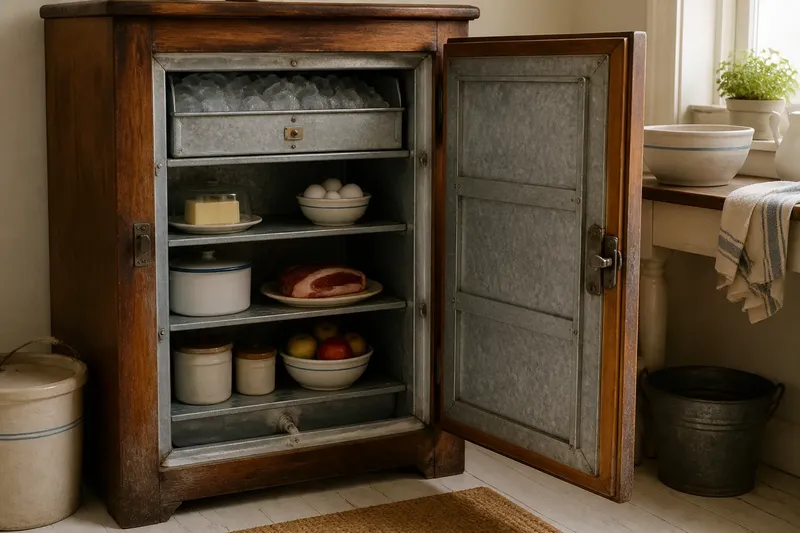
How did families keep milk, meat, and leftovers cool before the refrigerator? The home icebox used a block of delivered ice to chill an insulated cabinet, while household routines handled melting ice and runoff. Its design made cooling a daily kitchen task, not simply a feature of an appliance.
Cabinet and cold source
An icebox was a cupboard-sized cabinet, often made of wood outside and lined with metal inside. Cork, felt, or another insulating material sat between the inner lining and the outer case. The insulation slowed warmth from entering; the ice supplied the cold.
Most household models held a removable ice compartment near the top. As the ice melted, cold air sank through the storage space while warmer air rose toward the ice. A drain carried meltwater into a pan or through a pipe. The arrangement was like a lid on a pot: insulation slowed the exchange, but it could not stop warmth indefinitely.
Shelves and compartments helped separate food and make use of the available cold. The exact layout varied. Some cabinets had a small cold compartment for items that needed especially cool storage; others relied on open shelves below the ice chamber. An icebox was not a smaller version of a modern refrigerator with an even, mechanically controlled temperature. Its cooling depended on the ice supply, cabinet construction, how often the door opened, and where food sat.
Household fit
For a household with regular ice delivery, a home icebox offered a familiar way to keep perishable food cool without making ice at home. Its usefulness depended on access to ice and willingness to maintain the cabinet. A box that suited a household near a dependable delivery route might be inconvenient where ice was difficult to obtain.
A compact cabinet could suit a smaller household better than a large model. Less space meant fewer shelves to fill and less interior area to cool, though the household still needed a plan for purchasing and replacing ice. Size was a question of habits as much as kitchen dimensions: how much food needed cooling, how often people shopped, and where the box could be placed.
For a household with limited kitchen space, the icebox’s footprint and access to its drain mattered. It had to sit where someone could reach the food and handle the meltwater pan or drainage arrangement. A cabinet tucked into an awkward corner might save floor space but make daily upkeep harder.
Say a household keeps only a few items cool and receives ice from a nearby supplier. A modest icebox near the pantry would fit that routine better than a large cabinet across the kitchen, making stored food easier to reach and avoiding unused shelves. If deliveries were irregular, the household would need another way to obtain ice or accept that the icebox could not provide steady cooling.
Icebox questions?
How did families get ice?
Many households bought blocks from an ice dealer, who delivered them to homes or neighborhoods. The household chose how much ice to obtain and had to fit the block into its ice compartment, so delivery access shaped the cabinet’s usefulness.
What happened to meltwater?
Meltwater collected in a removable pan or flowed through a drain, depending on the design. Someone had to empty the pan or keep the drainage route clear, making the icebox part of the kitchen’s ongoing work.
Where did the icebox go?
It generally belonged in or near the kitchen, close enough for food handling and practical for ice delivery and drainage. Households needed access to the cabinet without letting its door obstruct the room or making routine use awkward.
Was an icebox the same as a refrigerator?
No. An icebox stored purchased ice and relied on insulation and natural air movement to cool its contents. A household refrigerator uses a powered cooling system, so it does not require a fresh block of ice as its source of cold.
Daily cabinet work
The icebox changed the rhythm of kitchen work. Someone had to arrange for ice, receive or carry it, place it in the compartment, and deal with water as it melted. Food had to be put away with the cabinet’s limited shelves and uneven cooling in mind. Even a well-insulated box asked for attention because its cold supply was gradually disappearing.
That work could fall into ordinary household routines: checking whether ice remained, deciding which items belonged inside, and emptying a drip pan before it overflowed. A convenient drain reduced one chore but did not remove the need to keep the area clean and accessible. The icebox was both storage furniture and a small piece of household infrastructure.
Its presence also shaped shopping and cooking. A household with space to cool leftovers or keep certain ingredients chilled had options that depended on having ice on hand. The box linked food preservation to delivery systems and neighborhood services, not only to decisions made inside the kitchen. If supply faltered, the cabinet’s limits became visible quickly.
Design and foodways
The icebox is easiest to understand as a system: an insulated shell, a removable cold source, a route for meltwater, and people who maintained the arrangement. Its materials addressed heat; its compartments organized food; its drain handled the consequence of melting ice. Each part made sense alongside the others.
Thinking about the icebox this way clarifies why its form differed from a modern refrigerator. It was designed around the arrival and gradual loss of a block, so access, drainage, and placement were central concerns. The refrigerator moved the source of cooling inside the appliance, changing the household’s relationship with ice and daily kitchen upkeep.
For anyone studying domestic food history, the practical question is not merely what the cabinet looked like, but what routine it required. A home icebox made cooling possible where ice could be supplied, and its design shows how preservation depended on both material objects and household labor.
Before the refrigerator, the home icebox joined the kitchen to a wider chain of delivery and maintenance. That connection is its most useful historical detail: the cabinet kept food cool, but access to ice determined how well the arrangement fit everyday life.